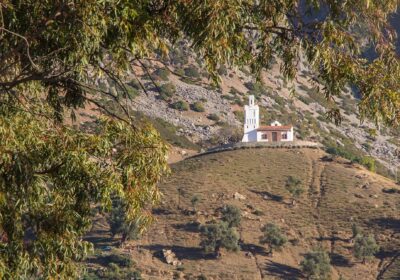

Most of the best day trips from Marrakech sit within three hours of the city, and the four that travelers book most often point in four completely different directions. Ourika is a green river valley in the High Atlas. The Ouzoud Waterfalls are a 110-meter cascade in the Middle Atlas foothills. Essaouira is a whitewashed port on the Atlantic. Agafay is a stony, lunar plateau 45 minutes from the medina. Each one shows a different Morocco, and each one suits a different kind of traveler.
This guide is written by the Morocco Trip Lines team, the driver-guides who run private day excursions from Marrakech every week. It compares the main options on drive time, what you actually do there and who each trip suits, then walks through each one with the stops and timings we use ourselves.
Marrakech is intense. The souks, the noise and the heat of the medina are a big part of its appeal, but after two or three days most travelers want a day outside the walls. The problem is choice: a quick search turns up dozens of excursions, and the descriptions often make every trip sound like the best one.
The honest answer is that the best day trip depends on three things: how long you are happy to sit in a vehicle, what you want to see, and the season. A family with young children in August will want something very different from a couple who love hiking in April. A first-time visitor who wants to see the ocean will be disappointed by a mountain valley, however beautiful it is.
So instead of ranking the trips, this guide helps you match them to your trip. Below we cover:
- A side-by-side comparison of the main day trips from Marrakech, with distances and drive times
- What a typical day looks like on each trip, stop by stop
- Shorter and longer options: Imlil, Lalla Takerkoust, Oukaimeden and Ait Benhaddou
- Private versus shared trips, and what to pack and budget for
- Which trip to choose for families, hikers, photographers and first-time visitors
How to Choose Between Day Trips From Marrakech
Before looking at each trip in detail, it helps to see them side by side. The table below uses typical one-way drive times from central Marrakech in a private vehicle, without long stops.
| Day trip | Distance one way | Drive time one way | Best for | Best season |
|---|---|---|---|---|
| Agafay Desert | About 40 km | 45 minutes | Sunset, short half days, families | All year, best evenings in summer |
| Ourika Valley | About 65 km | 1 hour 15 minutes | Easy walks, rivers, first-time visitors | Spring to autumn |
| Imlil and the High Atlas | About 65 km | 1 hour 30 minutes | Hiking, mountain villages | Spring to autumn |
| Ouzoud Waterfalls | About 150 km | 2.5 to 3 hours | Waterfalls, swimming, macaques | Spring and early summer |
| Essaouira | About 190 km | 2.5 to 3 hours | Ocean, medina, seafood | All year, cooler in summer |
| Ait Benhaddou | About 190 km | 3.5 to 4 hours | Kasbahs, film sets, the High Atlas pass | Spring and autumn |
Drive time is the first filter
The single biggest factor in how much you enjoy a day trip is the ratio of driving to doing. A trip with three hours each way leaves about four or five hours at the destination, which is fine for Essaouira or Ouzoud if you start early, but tiring if you are traveling with small children or jet lag.
As a rule of thumb, we suggest:
- Under 1.5 hours each way for a relaxed day or a half day
- 2.5 to 3 hours each way only with an early start, around 8:00
- Over 3.5 hours each way only if the destination is a priority, and ideally as an overnight trip instead
Match the trip to the season
Season changes everything. Agafay is hot at midday in summer but beautiful in the evening. Ourika is cool and green in spring but can be busy on summer weekends, when Marrakech families escape the heat. Essaouira is the best summer choice, because the Atlantic wind keeps it 10 or more degrees cooler than Marrakech. The falls at Ouzoud are at their fullest after the winter rains.
Think about what you want to do there
Some trips are about walking, some about looking and some about simply being somewhere different. Ourika and Imlil involve walking on uneven paths. Ouzoud involves a lot of steps. Essaouira is a city day, with flat streets and plenty of cafes. Agafay is mostly about the view and the light, with optional camel rides or quad biking.
With that in mind, here is what each of the main trips looks like in practice.
Ourika Valley: The Closest Mountain Escape
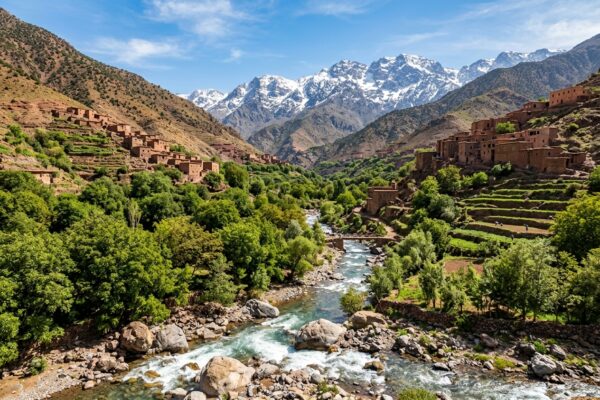
The Ourika Valley is the most popular of all day trips from Marrakech, and for good reason. Within about an hour and a quarter, the flat, dusty plain gives way to a green river valley lined with walnut trees, earthen villages and riverside cafes, with the snow-capped peaks of the High Atlas behind.
The drive and the first stops
The road leaves Marrakech heading south toward the mountains. After about 30 minutes, the first villages appear, and the landscape starts to climb. Most private trips stop at a Berber house along the way, where a family shows how they live, bake bread and make mint tea. It is a simple visit, but it gives a real sense of daily life in the valley.
If you travel on a Monday, ask your driver-guide to stop at the weekly souk in Tnine Ourika, a busy rural market where locals buy everything from vegetables to livestock. It is not a tourist market, which is exactly why it is interesting.
Setti Fatma and the waterfalls
The road ends at the village of Setti Fatma, the starting point for the walk to the seven waterfalls. The first waterfall is about 30 to 45 minutes uphill on a rocky path, with a few short scrambles and river crossings on stepping stones. Local guides wait at the start and are worth taking: the path is not always obvious, and they know which sections are slippery.
The higher waterfalls require more climbing, and most visitors stop at the first or second. Plan for about two hours for the walk and back, then lunch at one of the riverside restaurants, where tables sit on platforms over the water.
Who the Ourika Valley suits
The valley is ideal for first-time visitors who want a taste of the mountains without a long drive, and for families with older children who can manage the walk. It is less suited to travelers with limited mobility, because the best part involves rough paths.
A word of caution: the valley can be crowded on summer weekends and public holidays, when local families come up from Marrakech. If you can, go on a weekday, and leave early.
A typical day in Ourika
A private trip to the valley usually follows this rhythm, adjusted to your pace:
| Time | What happens |
|---|---|
| 8:30 | Pickup from your riad or hotel |
| 9:15 | Stop at a Berber house for tea and bread |
| 10:15 | Arrive in Setti Fatma and start the waterfall walk |
| 12:30 | Lunch at a riverside restaurant |
| 14:00 | Optional stop at a garden or cooperative on the way back |
| 15:30 | Back in Marrakech |
That leaves the late afternoon free, which is one reason the trip works so well for travelers who want to be back in the medina for dinner.
Weather and safety
The Ourika River can rise quickly after heavy rain in the mountains, even when the sky over Marrakech is clear. In spring and late summer, when storms are more likely, your driver-guide checks the forecast and will steer you away from the riverbanks if conditions change. Follow the local guides’ advice on the waterfall path.
Ouzoud Waterfalls: The Biggest Day Out
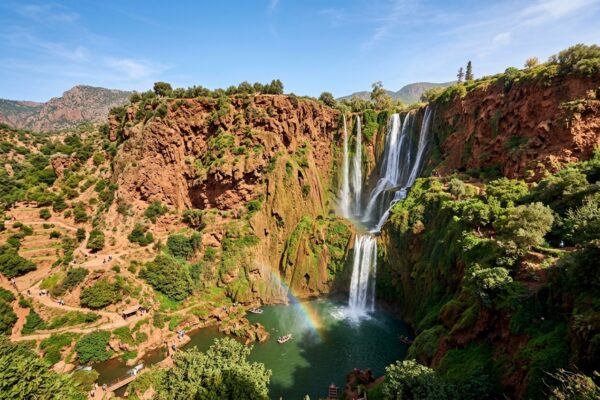
The Ouzoud Waterfalls are the most spectacular natural sight within a day’s drive of Marrakech. The river drops around 110 meters in several tiers into a green gorge, surrounded by olive groves and, often, rainbows in the spray. It is a longer trip, about two and a half to three hours each way, but for many travelers it is the highlight of their stay.
The road to Ouzoud
The drive heads northeast across the Haouz plain, then climbs gently into the foothills of the Middle Atlas toward the Azilal province. It is a quieter road than the routes south, with farmland, olive groves and small market towns. Your driver-guide will usually stop for coffee halfway, and the last section offers good views over the hills.
Walking down to the falls
From the village at the top, a path leads down past cafes and stalls to the viewpoints and the base of the falls. The walk down takes about 20 to 30 minutes, with many steps. At the bottom, small boats take visitors close to the spray, and in summer many people swim in the pools below the main falls.
You can walk back up the same way or follow a longer trail along the other side of the gorge, which gives the best views of the full cascade. Local guides offer this loop, and it is worth it if you are comfortable with steep paths.
Barbary macaques at Ouzoud
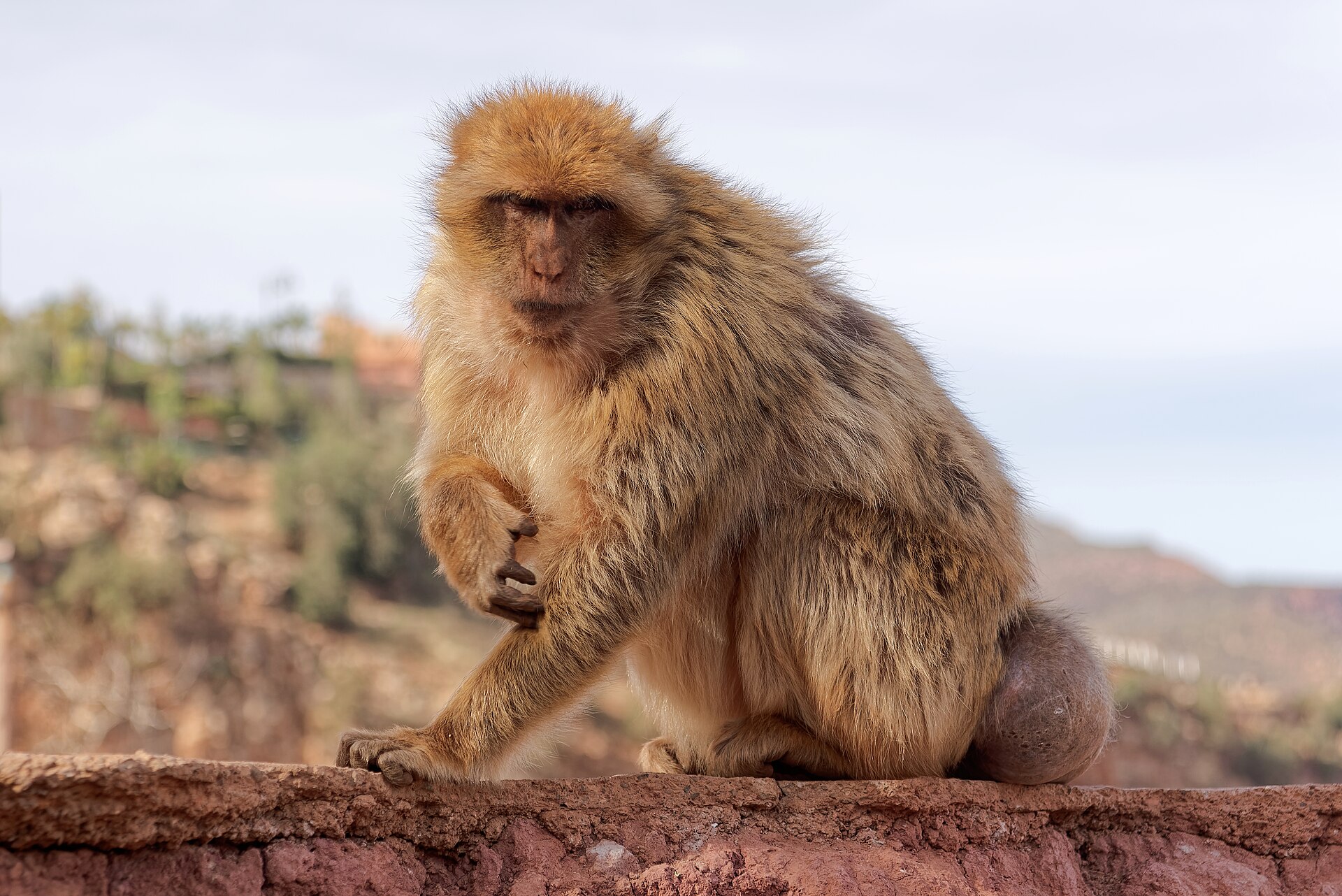
The olive groves around the falls are home to Barbary macaques, the endangered monkeys found only in Morocco and Algeria. They are used to visitors and often come close. Please do not feed them, even when others do: human food makes them ill and makes them more aggressive over time.
Lunch and timing
Lunch is usually at one of the terrace restaurants above the falls, many with direct views of the cascade. Plan for about four to five hours at Ouzoud in total, including lunch. With an 8:00 departure, you are back in Marrakech in the early evening.
Who the Ouzoud Waterfalls suit
This trip suits active travelers and families with children who can manage steps, and anyone who wants a full, memorable day out of the city. It is less suited to travelers who dislike long drives or who struggle with stairs, because the walk back up is the hardest part of the day. The falls are at their most impressive in spring, after the winter rains.
Essaouira: The Atlantic Day Trip
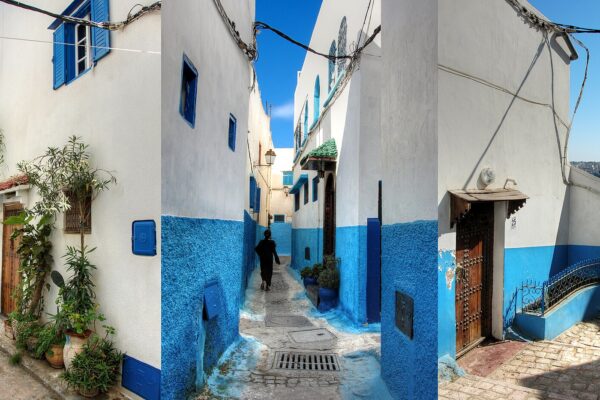
Essaouira is the opposite of Marrakech. Where Marrakech is red, hot and crowded, Essaouira is white and blue, breezy and relaxed. Its fortified medina, built by the sultan in the eighteenth century as a planned port, is listed by UNESCO as a World Heritage Site, and the town has a calm, artistic atmosphere that many travelers fall for.
The drive west
The road to Essaouira runs west across flat farmland and then through the argan forest, a landscape found almost nowhere else in the world. The drive takes about two and a half to three hours each way.
Along the road, you will see goats standing in argan trees. It is a famous photo, but you should know that many of these goats are placed there by herders who ask for a tip from passing tourists. Your driver-guide can stop if you want the photo, but the more interesting stop is a women’s argan oil cooperative, where you can see how the oil is extracted by hand and buy it directly from the people who make it.
Exploring the medina and the ramparts
Essaouira’s medina is compact, flat and easy to walk without a guide. The main sights are the Skala de la Ville, the sea ramparts lined with old cannons, the woodworking shops built into the walls and the busy fishing port, where blue boats unload the morning catch.
The souks here are far calmer than in Marrakech, and the town is known for its thuya wood carvings, art galleries and Gnawa music. Plan for about four to five hours in the town, including lunch.
Lunch at the port
For many visitors, lunch is the highlight. At the grill stalls by the port, you choose fresh fish and seafood from the display, agree a price, and it is cooked in front of you. Agree the price clearly before cooking starts, and check the weight if the fish is sold by the kilo.
Who Essaouira suits
Essaouira suits travelers who want a complete change of scene, families with children who want space to run, and anyone traveling in summer, when the coast is much cooler than Marrakech. It is less suited to those who dislike long drives, and on very windy days the beach is better for kitesurfers than sunbathers.
Essaouira through the seasons
Essaouira is one of the few day trips that works well all year. In summer, the trade winds keep the town cool and breezy while Marrakech bakes. In winter, the light is soft and the streets are quiet. Spring and autumn bring mild days and calmer seas. The one thing to plan for is wind: bring a layer even in July, and expect sand on the beach to blow.
The argan oil story
Argan trees grow almost only in southwestern Morocco, and the oil from their nuts is used both for cooking and for cosmetics. Extracting it by hand is slow work: the nuts are cracked between stones, the kernels roasted for culinary oil, then ground and pressed. Many cooperatives along the Essaouira road are run by women from the surrounding villages, and buying directly from them supports the local economy. Ask to see the process before you buy, and compare prices between cooperatives if you are buying a lot.
Staying overnight
Because the drive is long, some travelers prefer to stay a night in Essaouira and return the next day. If you are not short of time, this is often the better plan: the medina is at its most peaceful in the evening, after the day visitors leave.
Agafay Desert: Sunset Without the Long Drive
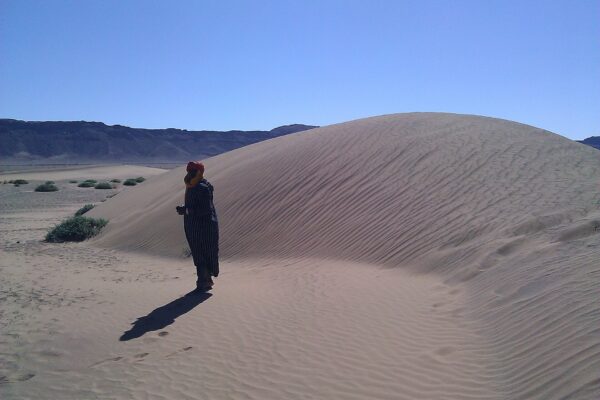
The Agafay Desert is the closest desert landscape to Marrakech, about 45 minutes from the medina. It is important to know what it is and what it is not. Agafay is a stony desert, a landscape of bare hills and gravel plains, not a sea of sand dunes like Erg Chebbi or Erg Chigaga. What it offers instead is space, silence and some of the best sunset views near Marrakech, with the High Atlas on the horizon.
What to do in the Agafay Desert
Most visits to Agafay are built around the late afternoon and sunset. Popular activities include:
- A camel ride across the plateau, usually around an hour
- Quad biking or a buggy ride across the hills
- Dinner at a desert camp, often with music and a fire after sunset
- Simply watching the light change from a viewpoint over the hills
Activities and dinner are booked with the camps and operators on the spot or in advance; your driver-guide can recommend trusted ones.
Combining Agafay with Lalla Takerkoust
On the way, the road passes Lalla Takerkoust, a large reservoir surrounded by hills, where some restaurants and lodges sit on the water’s edge. It makes a pleasant stop for lunch or a drink before heading up to the plateau for sunset.
Who the Agafay Desert suits
Agafay is perfect for travelers with only a few days in Marrakech who want a desert experience without the long drive to the Sahara. It also suits families with young children, and anyone who wants a half-day trip rather than a full day. In summer, plan to arrive in the late afternoon, after the worst of the heat.
Agafay versus the Sahara
If you have three days or more, the real Sahara dunes are reachable from Marrakech on a multi-day trip. Our Marrakech to Merzouga in 3 days guide explains what that involves, and the Marrakech to Zagora in 2 days guide covers a shorter option. Agafay is the right choice when you have one evening, not when you want dunes.
More Day Trips From Marrakech Worth Knowing
The four trips above are the most popular, but they are not the only options. These are the other day trips from Marrakech our travelers ask about most, from short half days to long, full days.
Imlil and the High Atlas villages
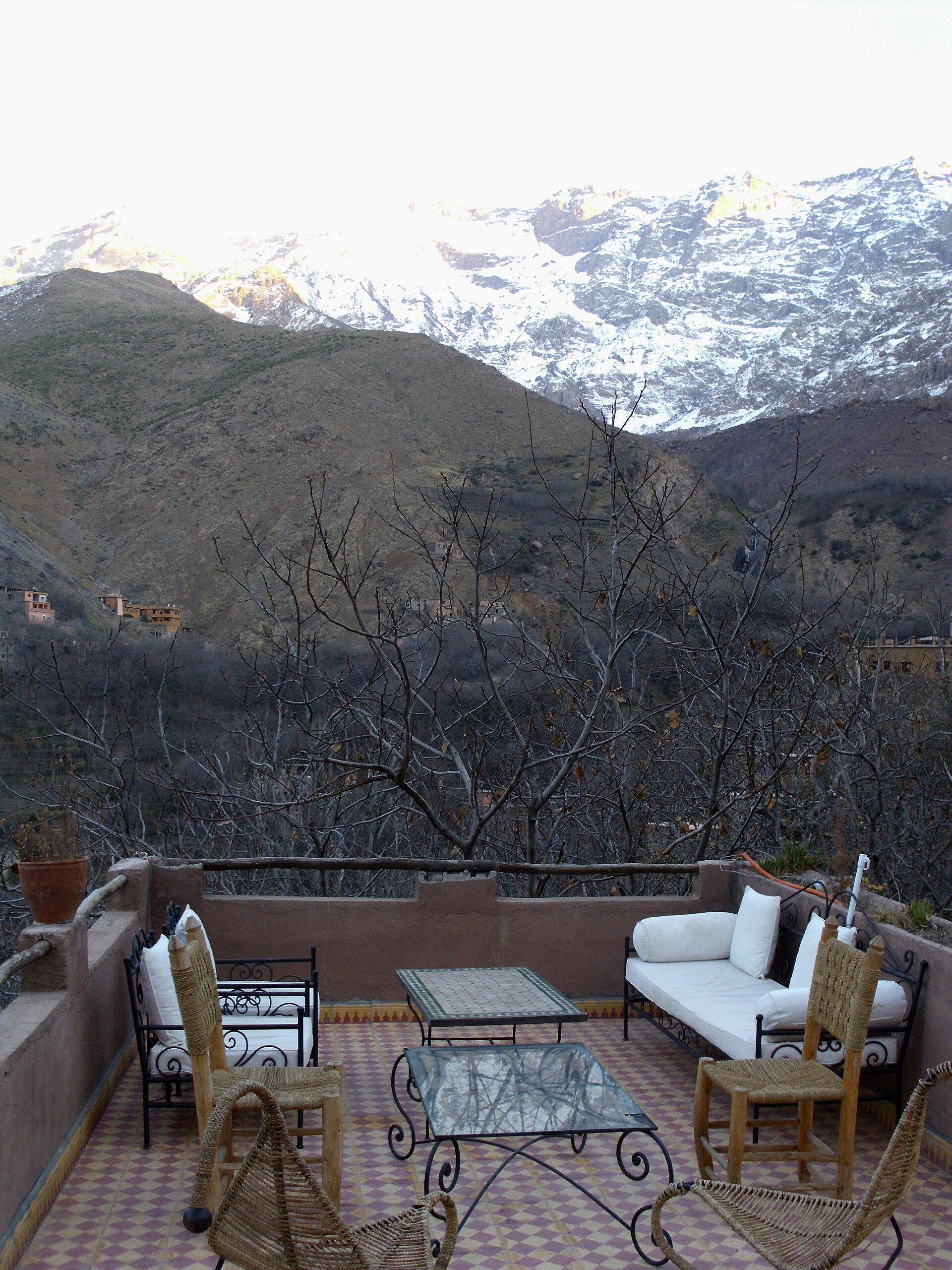
Imlil is a mountain village about an hour and a half from Marrakech, at the foot of Toubkal National Park. It is the starting point for treks to Mount Toubkal, North Africa’s highest peak, but it is also an excellent day trip in its own right. From Imlil, easy walks lead through walnut orchards and terraced fields to the village of Aroumd, with views up the valley toward the peaks.
Imlil suits hikers and travelers who prefer quiet mountain scenery over busier Ourika. If you want to climb Toubkal itself, that takes at least two days; our Toubkal trek guide explains the route.
Oukaimeden
Oukaimeden, about an hour and a half from Marrakech, is one of the highest ski areas in Africa. In winter, when there is snow, it offers simple skiing and sledding. The rest of the year it is a quiet high plateau with prehistoric rock carvings and good walking. It is a niche choice, but a memorable one if snow has fallen.
Ait Benhaddou and Ouarzazate
Ait Benhaddou is a fortified earthen village on the old caravan route, a famous film location and a UNESCO World Heritage Site. It is possible as a day trip, crossing the High Atlas over the Tizi n’Tichka pass, but it means three and a half to four hours each way. We usually recommend it as part of a multi-day route instead, such as the first day of our Marrakech to Casablanca in 4 days route.
Lalla Takerkoust on its own
For a gentle half day, Lalla Takerkoust alone is a good choice. The reservoir is about 40 minutes from Marrakech, with lakeside restaurants, a calm atmosphere and views of the Atlas, and it combines easily with Agafay.
Which Trip Works Best in Each Season
The weather around Marrakech changes a lot through the year, and some trips are far better in certain months. This is how our driver-guides think about it.
| Months | Weather in Marrakech | Best trips | Trips to reconsider |
|---|---|---|---|
| December to February | Mild days, cold nights, snow on the peaks | Agafay at midday, Essaouira, Oukaimeden when it snows | Long walks in Ourika after heavy rain |
| March to May | Warm days, green landscapes | Ouzoud at its fullest, Ourika, Imlil | Very few; this is the best season overall |
| June to August | Hot, often over 40°C at midday | Essaouira for the cool coast, Agafay at sunset, swimming at Ouzoud | Midday visits to the desert plateau |
| September to November | Warm days, clear light | Imlil, Ourika, Essaouira, Agafay at sunset | Ouzoud can be lower before the autumn rains |
Heat and timing in summer
In July and August, plan every trip around the heat. Leave early for the long drives, rest in the shade in the middle of the day, and keep the desert for the evening. Your private vehicle is air-conditioned, but the walks and viewpoints are not, so water and a hat matter more than anything else you pack.
Winter surprises
Travelers are often surprised by how cold the mountains are in winter. Snow can fall in Imlil and Oukaimeden, and the road to the higher villages occasionally closes for a few hours. Essaouira and Agafay are the most reliable winter choices.
Combining Two or Three Trips in One Week
Many of our travelers spend five to seven days in Marrakech and want to see more than one side of the region. The key is to alternate long and short days, so you never have two early starts and long drives in a row.
A sample five-day stay
- Day 1: Arrive and settle into the medina
- Day 2: Explore Marrakech on foot, with a guided half day in the medina
- Day 3: Full day to Ouzoud or Essaouira, leaving at 8:00
- Day 4: Slow morning in the city, then Agafay for sunset
- Day 5: Morning in Ourika or Imlil, back in time for a last dinner
This plan gives you the mountains, the falls or the ocean, and a desert sunset, without ever feeling rushed.
A sample three-day stay
With only three days, pick one short trip and keep the rest for the city. Agafay at sunset or a morning in Ourika both fit comfortably, and leave you time for the souks, the gardens and the palaces. Save the long drives for a longer visit.
When to book
In spring, autumn and over the Christmas holidays, private vehicles and the best local guides book up early, so it helps to send your dates a week or two ahead. In the quieter months, a day or two of notice is often enough.
Mistakes to Avoid on a Day Trip
Most day trips go smoothly, but a few common mistakes can turn a good day into a tiring one. Our driver-guides see them often enough that they are worth listing.
- Choosing the longest trip on your first full day. After a flight, a six-hour round trip is hard work. Start with something shorter.
- Leaving too late. A 10:00 departure for Ouzoud or Essaouira leaves too little time at the destination and brings you back after dark.
- Wearing the wrong shoes. Sandals are fine in Essaouira but not on the waterfall paths or the steps at Ouzoud.
- Carrying no cash. Local guides, boat rides, village cafes and tips are almost always cash only.
- Expecting sand dunes near Marrakech. The nearest desert is stony. For dunes, plan a multi-day trip.
- Trying to do everything. One great stop beats four rushed ones. Tell your driver-guide what matters most, and let the rest go.
None of these mistakes is serious, but avoiding them makes the day noticeably better.
Private or Shared: How to Plan Your Day Trip
Once you know where you want to go, the next decision is how. Day trips from Marrakech are sold in two main formats, and the difference matters more than the price suggests.
Shared group tours
Shared tours pick up from meeting points in Marrakech and travel in minibuses with 15 to 20 other passengers. They are cheaper per person, but the timing is fixed, stops are set by the group, and you often spend time waiting at shops chosen by the operator. They work well for solo travelers on a tight budget.
Private day trips
A private trip means your own vehicle and driver-guide, with pickup from your riad or hotel. You choose the departure time, how long you stay at each stop and where you eat. For families, couples and small groups, the price difference per person is often smaller than expected, and the day is far more relaxed.
At Morocco Trip Lines, our curated day excursions are private: the vehicle, fuel and driver-guide are covered, and you pay entrance fees, local guides, activities and meals directly. That keeps the price transparent and lets you choose exactly what you want to do.
Timing your departure
For the longer trips to the Ouzoud Waterfalls and Essaouira, leave by 8:00. For the Ourika Valley and Imlil, 8:30 or 9:00 is fine. For the Agafay Desert, plan to leave in the early or mid afternoon to arrive for sunset. Always tell your driver-guide your priorities in the morning, so they can plan the day around them.
What to pack
- Comfortable walking shoes with grip, especially for Ourika, Imlil and Ouzoud
- A light layer, even in summer, for the mountains and Essaouira’s wind
- Sunscreen, sunglasses and a hat
- Swimwear if you plan to swim at Ouzoud in summer
- Cash in small dirham notes for local guides, entrance fees, lunch and tips
Money and tipping
Many places on these trips do not take cards: village cafes, local guides, boat rides and small shops. Bring enough cash for the day. Tipping local guides is expected, and a tip for your driver-guide at the end of the day is appreciated but always at your discretion.
Travelers with limited mobility
Some trips are much easier than others for travelers who cannot manage steep paths or long flights of steps. Essaouira is flat and easy to explore on foot, and the port and ramparts are close to where vehicles can stop. Agafay and Lalla Takerkoust can be enjoyed largely from viewpoints and terraces. Ourika is lovely from the riverside restaurants even without the waterfall walk. The falls at Ouzoud are the hardest, because the best views involve many steps down and back up. Tell us about any mobility needs when you enquire, and we will suggest the most comfortable plan.
Choosing by traveler type
If you are still undecided, this quick guide matches each trip to the travelers it suits best:
- First-time visitors: the Ourika Valley or Essaouira
- Families with young children: the Agafay Desert or Lalla Takerkoust
- Active families and hikers: Imlil or the Ouzoud Waterfalls
- Photographers: Agafay at sunset or Essaouira’s port in the morning
- Summer travelers: Essaouira, for the cool coastal air
- Short on time: the Agafay Desert, as a half day
Day Trips From Marrakech FAQ
What is the best day trip from Marrakech?
There is no single best trip. The Ourika Valley is the easiest introduction to the mountains, the Ouzoud Waterfalls are the most spectacular, Essaouira gives the biggest change of scene, and the Agafay Desert is the best for a short sunset trip.
Which day trip from Marrakech is closest?
The Agafay Desert and Lalla Takerkoust are the closest, about 40 to 45 minutes from the medina. The Ourika Valley is about an hour and a quarter away.
Can I visit the Sahara on a day trip from Marrakech?
No. The large Sahara dunes at Merzouga and Zagora are too far for a day trip. The Agafay Desert is a stony desert close to the city; for real dunes, plan a trip of two days or more.
Is the Ourika Valley worth it?
Yes, especially for first-time visitors. The Ourika Valley combines Berber villages, riverside lunches and the walk to the waterfalls, all within a short drive. Go on a weekday to avoid the crowds.
How long do you need at the Ouzoud Waterfalls?
Plan for four to five hours at the falls, including the walk down, a boat ride or swim, lunch and the climb back up. With travel, it is a full day.
Is a day trip to Essaouira too long?
It is a long day, with about five to six hours of driving in total. It is very rewarding with an early start. If you can, stay a night instead.
Are day trips from Marrakech suitable for children?
Yes. The Agafay Desert, Lalla Takerkoust and Essaouira are the easiest with young children. The Ourika Valley and the Ouzoud Waterfalls suit older children who can manage rough paths and steps.
Do private day trips include lunch and entrance fees?
With Morocco Trip Lines, the private vehicle, fuel and driver-guide are included. Lunch, entrance fees, local guides and activities are paid directly, so you choose exactly what you want.
How much do private day trips from Marrakech cost?
The price depends on the destination, the vehicle size, the number of travelers and the season. We do not publish fixed prices; send your dates and group size through the enquiry form and we will reply with a personal quote.
Can I combine the Ourika Valley and Imlil in one day?
It is possible with an early start, because both are in the High Atlas south of Marrakech, but it makes for a rushed day. Most travelers enjoy one of them properly rather than two in a hurry.
What should I wear in the Agafay Desert?
Light, covering clothes and a scarf for the sun and dust, plus a warm layer for the evening. Temperatures on the plateau drop quickly after sunset, even in late spring and early autumn.
Can I go to Essaouira and back in one day with children?
Yes, many families do. Plan regular stops on the way, bring snacks for the drive, and give the children time on the beach. If they are very young, consider staying a night instead.
Which of the Day Trips From Marrakech Should You Pick?
The right choice comes down to three questions: how long you want to drive, what you want to see and what season it is. If you want the mountains with little driving, choose the Ourika Valley or Imlil. If you want a big natural spectacle, the Ouzoud Waterfalls are worth the long day. For the ocean and a calmer medina, go to Essaouira. For a sunset with almost no driving, the Agafay Desert is hard to beat.
Many travelers end up doing two of these day trips from Marrakech during a week in the city, and the best combinations pair a short trip with a long one, for example Agafay one evening and Essaouira or Ouzoud on another day. That rhythm keeps the week varied without ever feeling like a marathon.
The next step is simple: pick the trip that fits your dates and energy, then send us your plans through the Day Excursions page. Tell us your dates, group size and where you are staying, and we will reply with a private quote and a suggested schedule for the day.