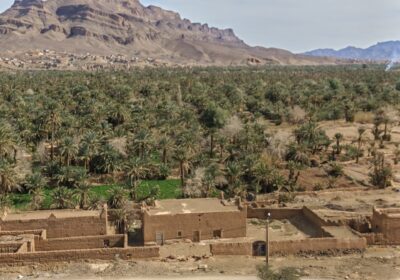

The sign at the top of the Tizi n’Tichka pass says 2,260 meters, but a 2022 GPS survey measured it at 2,205. That small gap sums up the 3 day desert tour from Marrakech pretty well: the brochure version and the real version are close, but the details are what make or break your trip. This guide gives you the real version, day by day, from the people who drive this road every week.
Prefer a dedicated driver-guide for this route?
- Private air-conditioned vehicle + professional licensed driver-guide
- Flexible pace with customized stops along the mountain passes and valleys
- You choose and book your own preferred hotels and desert camps
- Instant quote requests via WhatsApp and Email
Most travelers who land in Marrakech have the same plan in the back of their minds. They want one night in the Sahara, a camel ride at sunset, and a sky full of stars, and they want it without losing a week. The Marrakech to Merzouga route delivers exactly that, but it asks for a lot of hours in a vehicle, and nobody explains the trade-offs clearly before you book.
So we will. You will learn what each of the three days really looks like, how long the drives are, what the desert camp is like, when to go, what to pack, and how to tell a well-run Merzouga desert tour from a rushed one.
You will also learn when this trip is the wrong choice for you, because sometimes it is.
Why the 3 Day Desert Tour From Marrakech Is So Popular
Merzouga sits on the western edge of Erg Chebbi, a sea of orange dunes close to the Algerian border. These are the tallest, most photographed dunes in Morocco, and they are the image most people picture when they say “the Sahara.” Getting there from Marrakech means crossing the High Atlas, following the old caravan valleys of the south, and driving more than 500 kilometers each way.
That distance is why the three-day format exists. Two days is technically possible, but it turns into a blur of tarmac. Four days or more is more comfortable, yet many visitors have only a long weekend to spare between the medina, the riad and the flight home.
The problem this guide solves
Here is the situation we hear about most often from guests. You have a few days in Marrakech, you have seen dozens of near-identical tour listings, and you cannot tell which one fits you. Some say “luxury camp,” some say “standard camp,” some hide the drop-off time, and almost none tell you how long you will sit in the car.
You want to understand what this trip involves so you can book the right one with confidence, explain the plan to your travel partner, and arrive at the dunes rested instead of frazzled. Everything below is organized around that goal.
What makes our angle different
We are a local private tour company, so we have an obvious interest in you booking with us. We would still rather you book the right trip than the wrong one with us. That is why this guide includes the honest downsides of the route, the questions to ask any operator, and the cases where a shorter desert trip or a longer loop makes more sense.
The roadmap is simple. First, the route and why it is shaped the way it is. Then each day in detail, the camp, the seasons, packing and costs, how to choose an operator, and finally the common questions we answer every week.
The Marrakech to Merzouga Route at a Glance
Before the daily detail, it helps to see the whole loop. A classic 3 day desert tour from Marrakech runs east over the mountains, south-east through the oases, and back the same way. The table below is the version most private tours follow, with realistic driving times that include short photo and coffee stops.
| Day | Route | Driving time (approx.) | Night |
|---|---|---|---|
| 1 | Marrakech, Tizi n’Tichka, Aït Benhaddou, Ouarzazate, Dades Valley | 6–7 hours | Dades Valley hotel |
| 2 | Dades Gorge, Tinghir, Todra Gorge, Erfoud, Rissani, Merzouga | 5–6 hours, then a camel ride | Desert camp in Erg Chebbi |
| 3 | Merzouga, back west through the valleys, Tizi n’Tichka, Marrakech | 9–10 hours | Home in Marrakech |
Why the Marrakech to Merzouga road goes this way
The road from Marrakech to Merzouga follows the logic of the land. The High Atlas blocks the direct path, so every route has to climb over it, and the N9 over Tizi n’Tichka is the main crossing. Once you drop down to Ouarzazate, the valleys of the Dades and the Todra run east like a corridor, and they lead you toward the dunes.
This is the same line that trade caravans used for centuries. Rissani, near the end of the route, stands close to the site of Sijilmassa, a kingdom that grew rich between the 8th and 14th centuries by controlling the trans-Saharan caravan routes. You are, quite literally, driving a trade road.
The honest trade-off
The third day is the one nobody likes to talk about. Getting from the dunes back to Marrakech in one go means close to a full day on the road. It is doable, the scenery is good, and a careful driver makes it comfortable, but it is long.
If that worries you, read the section on alternatives before you book. There are ways to keep the dunes and lose some of the driving.
Day 1: Crossing the High Atlas to the Dades Valley
Your 3 day desert tour from Marrakech starts early. Most private tours collect you from your riad or hotel at around eight in the morning, which gives you time for breakfast and gets you over the mountains before the midday light flattens the views.
The first hour is the drive out of the city and across the Haouz plain, past olive groves and red-earth villages. Then the road starts to climb.
Over the Tizi n’Tichka pass
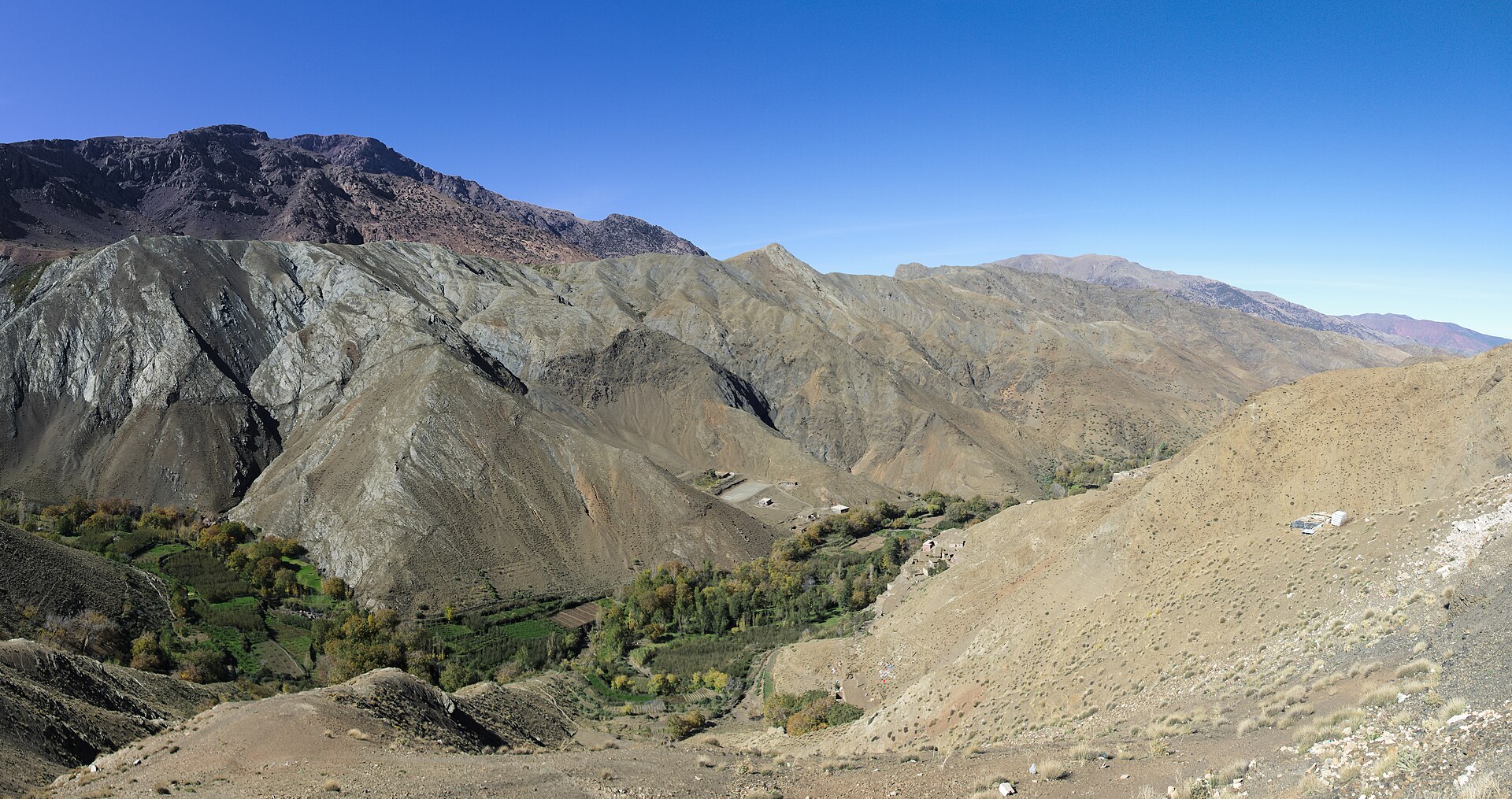
Tizi n’Tichka is the highest major mountain pass in North Africa. The French military built the modern road in 1936, laying it along an old caravan trail, and today it is the N9 that links Marrakech with Ouarzazate. The road twists through Berber villages built from the same earth as the hillsides, with walnut trees in the valleys and snow on the peaks in winter.
Remember the sign at the top. It still reads 2,260 meters, while the Tizi n’Tichka GPS figure is 2,205. Either way, you will feel the cooler air, so keep a layer handy even in spring.
A good driver will stop at a viewpoint or two, and at a village where you can see how argan oil or local pottery is made. Ask your driver to keep stops to the ones that interest you. On a private tour, that is your call.
Aït Benhaddou, the fortified village
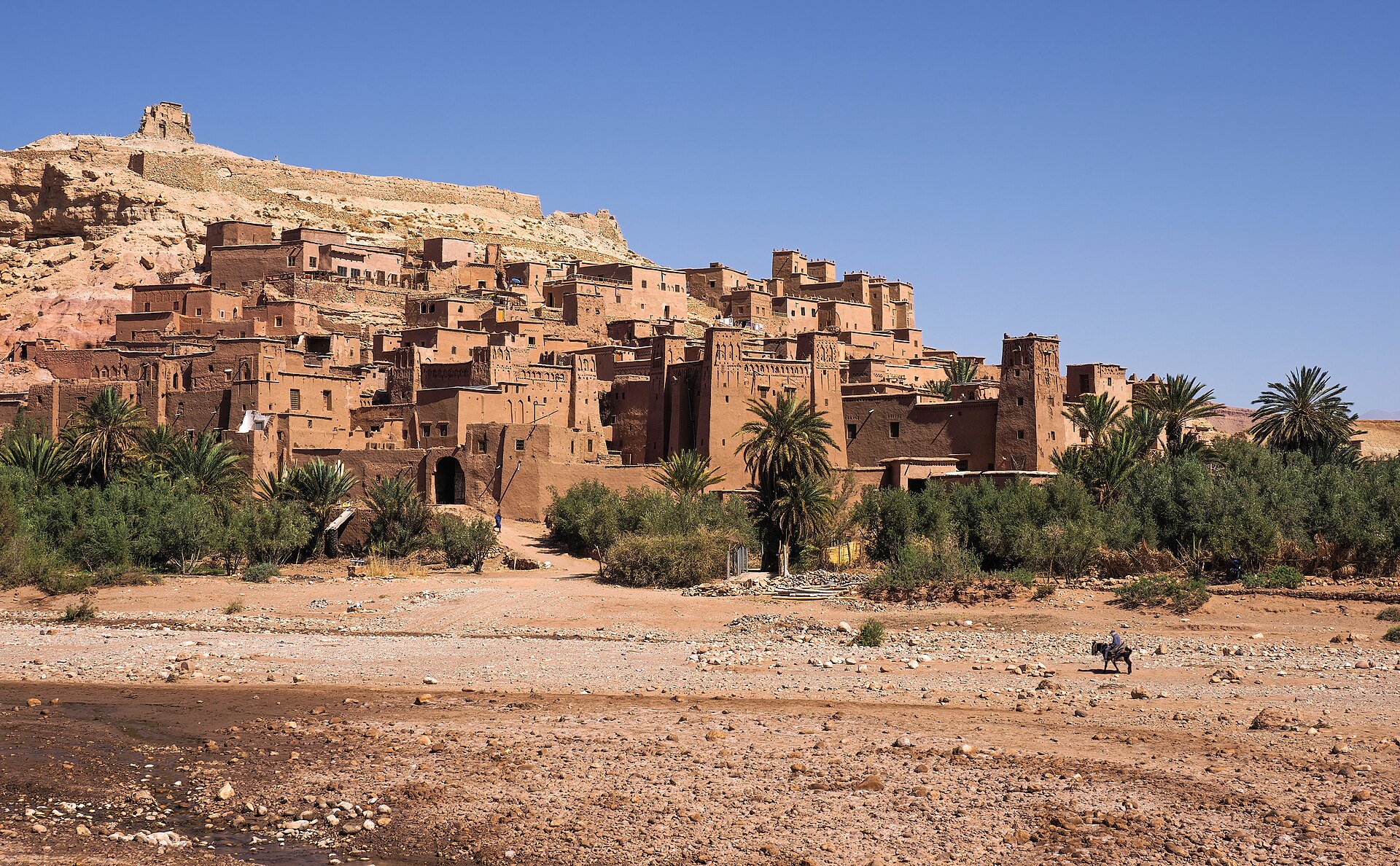
Around midday you reach Aït Benhaddou, the most famous stop of the whole trip. It is a ksar, a fortified village of earthen houses and towers stacked up a hillside above the Ounila River. The buildings are made from rammed earth, adobe, clay bricks and wood, which is why they glow gold and red in the afternoon sun.
UNESCO inscribed the Ksar of Aït-Ben-Haddou as a World Heritage Site in 1987. Only a few families still live inside the old walls; most residents have moved to the newer village across the river. You will probably recognize the skyline, because more than 25 films and series have been shot here, from Lawrence of Arabia to Gladiator and Game of Thrones.
Plan about an hour to walk up through the alleys to the old granary at the top. The view over the valley is the best photo of the day. Lunch is usually in one of the terrace restaurants facing the ksar.
Ouarzazate and the road of kasbahs
After lunch you pass through Ouarzazate, sometimes called the door of the desert. It is home to large film studios, and some tours stop for a quick visit. If you would rather spend that time elsewhere, say so in advance.
East of Ouarzazate the landscape opens up. This stretch is often called the Road of a Thousand Kasbahs, and it earns the name: earthen fortresses stand along the river, some restored, many slowly melting back into the ground.
The Valley of Roses and the Dades Valley
The road passes Kelaat M’Gouna, the heart of Morocco’s rose-growing area. In spring the hedges along the fields bloom pink, and the town makes rose water and rose cosmetics from the harvest. Outside spring, a short stop at a cooperative still shows you how it works.
You end the day in the Dades Valley, where the river has cut deep gorges through sandstone and limestone that formed on an ancient seabed. Your hotel is usually perched above the valley, so dinner comes with a view of the cliffs turning purple at dusk. After six or seven hours on the road, you will be glad of an early night.
Practical tips for day one
- Sit on the right-hand side of the vehicle for the best mountain views on the way up.
- Bring motion-sickness tablets if you are sensitive; the pass has many hairpin bends.
- Carry small change in dirhams for toilets, tips and snacks at roadside stops.
- Agree on the lunch stop with your driver in the morning so you are not hungry at 3 p.m.
Day 2: Gorges, Oases and the Merzouga Dunes
Day two is the heart of any Sahara desert tour from Marrakech, and it is the most varied day of the three. You wake up in a canyon, walk through a palm oasis, stand at the foot of 400-meter cliffs, cross a stony desert plateau, and end the day riding a camel into the dunes.
Through the Dades Gorge

Many itineraries start with a short drive up the Dades Gorge before heading east. The road climbs in tight switchbacks, and the rock formations along the river look like folded fabric. It is one of the most photographed roads in the country, and the light is at its best in the morning.
Tinghir and the palm oasis
Next comes Tinghir, a town at the edge of a long ribbon of palm groves. Walking through the oasis with a local guide is one of the most memorable parts of the trip for many guests. You follow irrigation channels between date palms, fig trees and small plots of wheat and vegetables, with mud-brick villages on the slopes above.
This is where you see how people actually live in the south. Ask questions. Your guide will explain how water is shared between families, a system that has worked for generations.
Todra Gorge
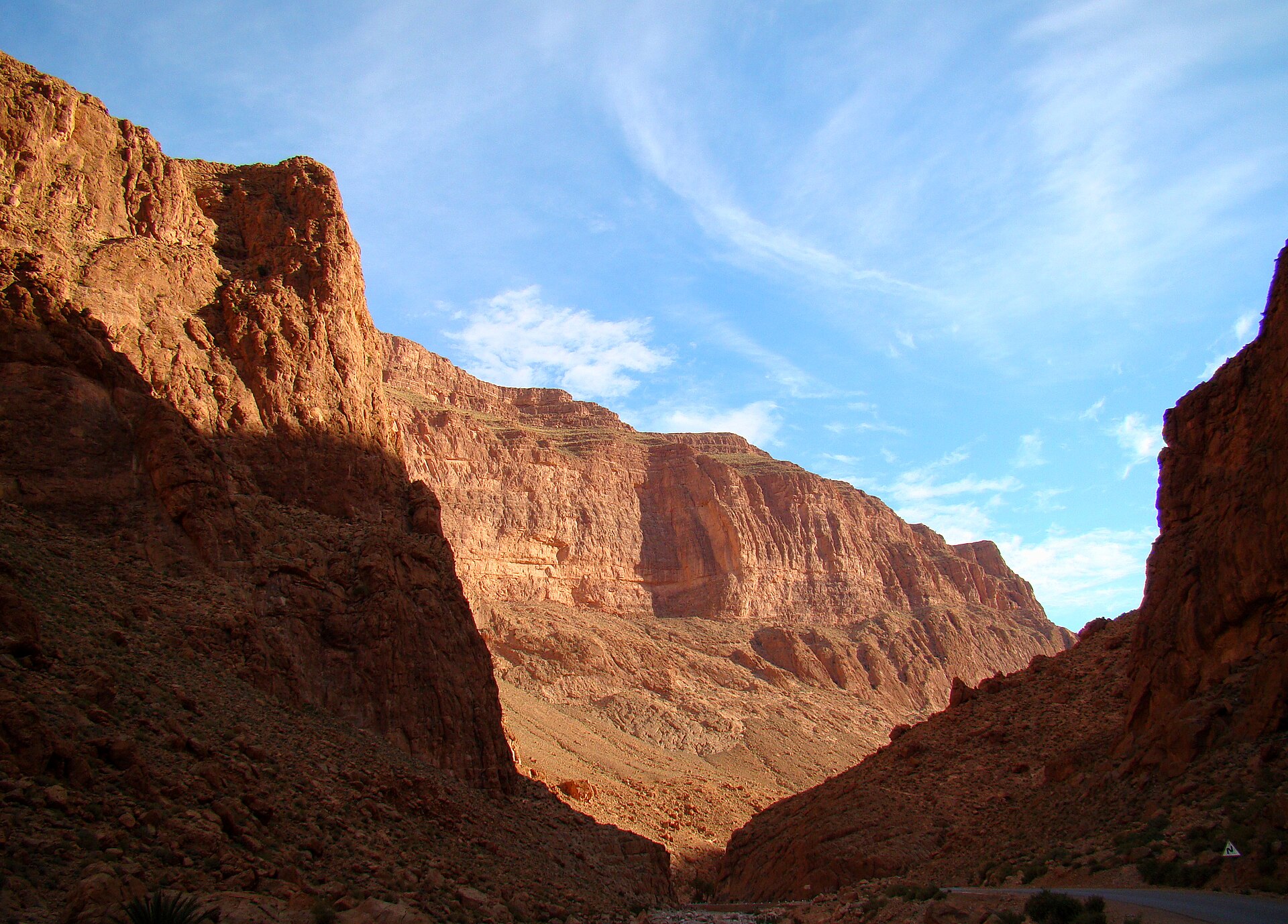
A few kilometers beyond Tinghir, the valley closes into the Todra Gorge (also written Todgha). The canyon walls rise up to about 400 meters, and in its narrowest section the gorge squeezes down to about 10 meters wide. A clear stream runs along the bottom, and you can walk in on foot from the road.
The Todgha Gorge is cooler than the valley outside, which makes it a good place for a break and a mint tea. Rock climbers come here from all over Europe, and you may see them working on the walls above you.
Erfoud, Rissani and the approach to the Sahara
After the gorge, the land changes. The mountains fall behind and you cross the hamada, the flat stony desert that surrounds the dunes. The towns of Erfoud and Rissani are the last stops before Merzouga.
Erfoud is known for its fossil workshops, where marble full of ancient sea creatures is cut and polished. Rissani has one of the busiest traditional markets in the south and, as mentioned earlier, sits near the ruins of medieval Sijilmassa. A short stop at either is enough; the dunes are waiting.
Arriving at Erg Chebbi

Erg Chebbi, the goal of every Merzouga desert tour, stretches about 28 kilometers from north to south and 5 to 7 kilometers from east to west. In places the Erg Chebbi dunes rise up to 150 meters above the surrounding desert floor. The first sight of them, glowing orange above the flat grey hamada, is one of the moments people remember for years.
You usually reach Merzouga in the late afternoon. You leave your large luggage in the vehicle or at a guesthouse, take a small bag with essentials for the night, and meet your camel guide. This is the moment your Merzouga desert tour has been building toward.
The Merzouga Desert Tour Camp Experience
On a Merzouga desert tour, the camel ride into the dunes takes roughly an hour to an hour and a half, timed so you reach a high ridge for sunset. Camels walk slowly and sway, so hold on to the saddle handle, lean back going downhill, and do not worry if the first few minutes feel awkward. Everyone feels awkward.
Sunset in the dunes
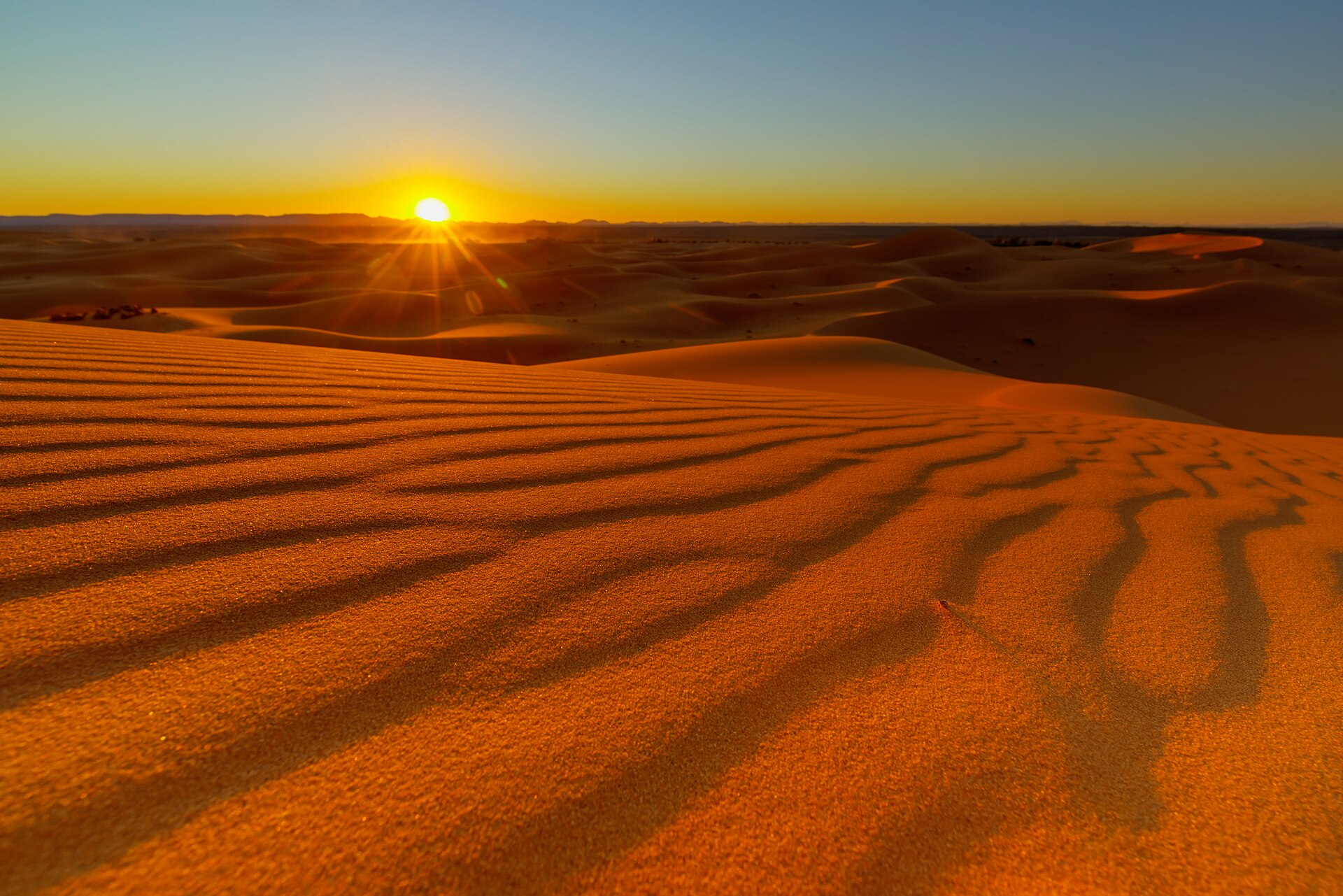
Your guide will stop on a dune crest so you can climb a little higher on foot and watch the sun go down. The sand changes from gold to orange to deep red within half an hour, and the shadows of the ridges stretch across the valley. Phones come out, and then most people just sit and watch.
Take a moment to look east as well as west. The dunes facing away from the sun turn pink and violet, and on a clear evening you can see the shadow of the earth rising on the far horizon.
What the desert camp is like
Desert camps around Erg Chebbi range from simple to genuinely comfortable. This is the single biggest variable in any Merzouga desert tour, so it pays to know the vocabulary before you book.
| Camp type | Typical setup | Who it suits |
|---|---|---|
| Standard or traditional camp | Tents with beds and blankets, shared toilets and washrooms | Budget travelers, younger groups, people who want a simpler night |
| Comfort camp | Larger tents, proper beds, some with private bathrooms | Most couples and families |
| Luxury camp | Private tent with ensuite bathroom, hot shower, real mattresses and linen | Travelers who want hotel comfort in the dunes |
None of these is “camping” in the backpacking sense. You will sleep in a bed under a heavy blanket, and dinner is served at the camp. What changes is mainly the bathroom, the size of the tent and the level of service.
Dinner, drums and stars
Dinner at camp is usually a three-course Moroccan meal: soup or salads, then a tagine or couscous, then fruit. Afterward, the camp staff often light a fire and play traditional drums. If you want quiet, walk a few minutes up the nearest dune.
The stars are the reason many people take a Sahara desert tour in the first place. Merzouga has very little light pollution, and on a moonless night the Milky Way stretches overhead from horizon to horizon. Check the moon phase when you choose your dates if stargazing matters to you; a full moon is beautiful, but it washes out the fainter stars.
Sunrise and the morning ride
Most camps wake guests before dawn for sunrise. You can watch from the top of a dune near the camp, or ride the camels back to the village as the light comes up. Breakfast follows, then a shower at a guesthouse in Merzouga if your camp does not have one, and you are back in the vehicle.
A sample timeline for the camp evening
Every Merzouga desert tour runs to the sun, not the clock, so timings shift with the seasons. As a rough guide, here is how a typical evening unfolds in spring or autumn:
- Late afternoon: arrive in Merzouga, drop your large luggage and meet the camel guide.
- About an hour before sunset: set off on the camels into the dunes.
- Sunset: stop on a high ridge, climb on foot and watch the light change.
- After dark: arrive at camp, settle into your tent and wash up.
- Evening: dinner, then drums by the fire or quiet stargazing on the dunes.
- Before dawn: wake for sunrise, then breakfast and the ride back.
In summer everything moves later, and in winter it starts earlier. Your guide will set the times on the day, so there is no need to plan it to the minute.
Day 3: The Long Drive Back to Marrakech
Day three is the price you pay for squeezing a Sahara desert tour into a short trip. Expect nine to ten hours of travel between the dunes and your riad, including stops. Most tours drop guests back in Marrakech in the early evening.
How a good driver makes day three easier
The secret to a good return day is pacing. A careful driver breaks the trip into stages with a stop roughly every two hours: a coffee, a stretch at a viewpoint, a proper lunch, and a final break before the mountain pass. It also helps to take a slightly different road in places, so the scenery does not feel like a rerun.
Some tours return through the Draa Valley and the town of Agdz instead of retracing the Dades route. The Draa is lined with palm groves and kasbahs, and it gives you something new to look at in the afternoon. Ask about this option when you book.
Ways to break up the return
If you have one more day, adding a night on the way back changes the whole trip. Ouarzazate, Skoura or the area around Aït Benhaddou are all good places to stop, and the last day becomes a relaxed half-day drive over the mountains. That turns a 3 day desert tour from Marrakech into a four-day loop, but many guests tell us it is the best change they made.
Not ending in Marrakech is another option on a Sahara desert tour. If your trip continues to Fes, a route from Marrakech to Merzouga and on to Fes avoids the backtrack entirely, and the drive north through the Ziz Valley and the cedar forests of the Middle Atlas is beautiful.
Making peace with the drive
If you go with the classic Marrakech to Merzouga loop, treat day three as a scenic journey rather than dead time. Download podcasts or a film, keep snacks and water in the car, and ask your driver about the places you pass. The High Atlas looks different in the late afternoon light, and many guests say the second crossing is the better one.
Best Time for a Sahara Desert Tour From Marrakech
The best months for a Sahara desert tour are generally October to April. Days are warm and pleasant, nights are cool to cold, and the light is soft for photos. That does not mean the rest of the year is off limits, but each season changes the experience.
Spring (March to May)
Spring is the favorite season for a 3 day desert tour from Marrakech. The desert is warm but comfortable, the Valley of Roses blooms around May, and the mountain villages are green. It is also busy, so book camps and good hotels early, especially around European school holidays.
Summer (June to August)
Summer days in the desert are very hot, and midday temperatures can be hard on anyone not used to them. The trip still works if you plan around the heat: early starts, long breaks in the shade at midday, and camel rides only at sunrise and sunset. Air-conditioned vehicles and camps with ensuite showers matter much more in July than in March.
Autumn (September to November)
Autumn brings back comfortable temperatures and clear skies for a Sahara desert tour. October and November are some of the best months for this trip, with warm afternoons, cool nights and fewer crowds than spring. Late in the season, the High Atlas can see its first snow.
Winter (December to February)
Winter days are sunny and mild in the desert, but nights can drop close to freezing. Camps provide heavy blankets, and many luxury camps have heated tents or hot water bottles. The bigger risk in winter is the Tizi n’Tichka pass, which occasionally closes for a few hours after heavy snow. A good operator watches the forecast and adjusts timing.
Ramadan and holidays
During Ramadan, tours run as normal, though some roadside cafes keep shorter hours during the day. Around major holidays, roads and camps get busier with Moroccan families traveling too, which can be a lovely atmosphere if you book ahead.
What to Pack for Your Merzouga Desert Tour
On any Merzouga desert tour you will leave your big suitcase in the vehicle for the night in the dunes, so pack a small overnight bag before you reach Merzouga. Here is what we recommend to our own guests.
The overnight desert bag
- A warm layer for the night, even in late spring: fleece or light down jacket
- Comfortable trousers and a long-sleeved top for the camel ride
- A scarf or cheche to protect your face from sun and wind-blown sand
- Sunglasses, sunscreen and lip balm
- A headlamp or small torch for walking around camp at night
- Wet wipes and a small toiletry kit
- Phone, power bank and a charging cable (camps vary in how much power they offer)
- Any medication you need overnight
What to wear on each day
On a 3 day desert tour from Marrakech, day one and day three are mostly driving, so comfort matters most. Day two involves walking in the oasis and the gorge, then sand. Closed shoes or sandals that hold your feet firmly work best; flip-flops slip off on the dunes.
Dress modestly in villages and towns as a courtesy: shoulders and knees covered is a good rule of thumb for both men and women. In the camp and on the dunes, practical clothing is all that matters.
Cameras and electronics
Fine sand gets everywhere. Keep your camera in a zip bag when you are not using it, and change lenses inside the tent rather than on the dunes. A small cloth for wiping screens and lenses is worth bringing.
How Much a 3 Day Desert Tour From Marrakech Costs
Prices for a 3 day desert tour from Marrakech vary widely, and comparing listings is confusing because they rarely include the same things. Instead of quoting a single number, here is what drives the cost, so you can compare tours properly.
What changes the price
- Shared or private. Shared group tours fill a minibus with other travelers and follow a fixed schedule. Private tours give you your own vehicle and driver, and the flexibility to stop where you want.
- Camp level. The jump from a standard camp to a luxury camp with ensuite bathrooms is usually the biggest single difference in price.
- Hotel on night one. A simple guesthouse and a boutique hotel above the Dades Gorge can be very different experiences.
- Group size. On private tours, the vehicle cost is shared, so the price per person falls as the group grows.
- Season. Spring and autumn peaks can raise camp prices.
What is usually included, and what is not
While generic group tours often bundle rigid accommodation markups, Morocco Trip Lines operates strictly on a private transport model. Morocco Trip Lines provides private door-to-door transport with a dedicated professional driver-guide. Accommodation, desert camps, meals, and local site guides are arranged and booked directly by travelers, giving you complete flexibility and transparent pricing. Ask for a written list of inclusions and exclusions before you pay a deposit.
If budget is the main concern, a shorter trip helps most: our 2 day desert tour from Marrakech guide explains the least expensive overnight option, to a desert camp near Zagora.
Is the cheapest option worth it?
A very cheap 3 day desert tour from Marrakech often saves money in ways you only notice on the road: large groups, long shopping stops, a camp far from the high dunes, or a driver covering two tours in one week without rest. We are not saying every budget tour is bad, but the lowest price usually means one of these. Ask about each of them directly.
How to Choose the Right Marrakech to Merzouga Operator
With so many tours on the market, choosing comes down to asking the right questions. These are the ones we would ask if we were booking a Marrakech to Merzouga trip ourselves.
Ten questions to ask before you book a Sahara desert tour
- Is this a private tour or a shared group tour?
- What time is pickup, and what time will we realistically be back on day three?
- What vehicle will we travel in, and does it have working air conditioning?
- Which hotel is included on night one, and is the room ensuite?
- Which camp is included, how far is it from the dunes, and does our tent have a private bathroom?
- How long is the camel ride, and is there an option for guests who prefer not to ride?
- Are dinners and breakfasts included on both nights?
- Which stops are guided, and which local guides cost extra?
- Can we change the route, for example ending in Fes or adding a night?
- What happens if the Tizi n’Tichka pass closes or someone falls ill?
A good operator answers all of these clearly, in writing, without pressure. If answers are vague, that tells you something.
Why we prefer private tours for this route
On a long route like Marrakech to Merzouga, a private vehicle makes the biggest difference to comfort. You set the pace, you choose the stops, you do not wait for twelve strangers at every viewpoint, and your driver can adapt to the weather, your energy and your interests.
At Morocco Trip Lines, every desert trip we run is private and tailored, with no hidden fees and support available around the clock while you travel. Tell us what matters most to you, whether that is photography, food, quiet nights or time with your kids, and we will shape the three days around it. You can see the itinerary on our 3-day private Marrakech to Merzouga desert tour page, or contact our team with your dates.
Red flags to watch for
- No written itinerary or list of inclusions
- A camp described only as “Berber camp” with no name or photos
- Pickup times far earlier than necessary to fit extra shopping stops
- Prices that change after you have paid the deposit
- No clear plan for bad weather or road closures
Is a 3 Day Desert Tour From Marrakech Right for You?
Here is the contrarian part. For many travelers, the three-day loop is perfect. For some, it is the wrong trip, and they would enjoy Morocco more with a different plan.
Who will love it
- Travelers with limited time who want the high dunes of Erg Chebbi, not smaller dunes, from their Sahara desert tour
- People who enjoy road trips and changing scenery
- Photographers who want Aït Benhaddou, the gorges and the dunes in one trip
- Couples and friends who want one memorable night in the desert
Who should think twice
- Travelers who get car sick easily, because the mountain roads are winding and the drives are long
- Families with very young children who struggle with long days in a car seat
- Anyone with only two full days to spare
Better alternatives for some travelers
If the driving is the main worry, you have options. A two-day trip from Marrakech to the dunes near Zagora halves the distance; the dunes are smaller, but you still get the camel ride and the camp. The Agafay stone desert, under an hour from Marrakech, gives a taste of desert scenery and a night under the stars with almost no driving.
If you have more time, a four-day loop via Zagora or a route from Marrakech to Merzouga ending in Fes is far more relaxed. Flying home from Casablanca? Our 4-day desert tour from Marrakech to Casablanca crosses the Sahara on the way. Families can ask us to add an extra night to break up the long drives, and keen hikers can pair the dunes with North Africa’s highest peak, as described in our Toubkal trek guide.
A note on safety and travel advice
The Marrakech to Merzouga route is well traveled, and private tours here are routine. Still, check your government’s official travel advice before any trip; for British travelers, the UK Foreign Office advice for Morocco is updated regularly. Travel insurance that covers your activities, including the camel ride, is always a good idea.
3 Day Desert Tour From Marrakech FAQ
How long is the drive from Marrakech to Merzouga?
The Marrakech to Merzouga drive covers more than 500 kilometers. Even without stops it is most of a day at the wheel, which is why a 3 day desert tour from Marrakech splits the outward journey over two days with a night in the Dades Valley.
Can I do the Merzouga desert tour in two days?
You can, but you will spend most of both days driving and arrive at the dunes tired. If you only have two days, the dunes near Zagora are a better choice. For Erg Chebbi, three days is the sensible minimum.
Is the camel ride suitable for everyone?
Camel rides suit most people in reasonable health. The ride lasts around an hour each way and involves some swaying. If you have back problems, are pregnant or simply prefer not to ride, many camps can arrange a 4×4 transfer instead.
Are the desert camps safe?
On a Sahara desert tour, established camps around Erg Chebbi are run by experienced local teams and are used to hosting international guests every night. Choose a named camp with real photos and reviews, and keep valuables in your small overnight bag.
Will I have Wi-Fi or phone signal in the desert?
Phone signal is often available near Merzouga and patchy deeper in the dunes. Some camps offer Wi-Fi in a common area. Treat the night as a chance to disconnect, and download anything you need before you leave.
What is the best month for a Sahara desert tour?
October, November, March and April are usually the most comfortable months for a Sahara desert tour. Winter is sunny but very cold at night, and summer is very hot in the middle of the day.
Is this trip suitable for children?
Yes, a Merzouga desert tour works for families with good pacing. Children usually love the camels and the dunes, but long drives are hard for younger kids. Consider adding a night on the way back so day three is shorter.
Can the tour end somewhere other than Marrakech?
Yes. On a private Merzouga desert tour you can end in Fes, which avoids the long backtrack, or arrange other drop-offs. Ask when you book, as the route and timing will change.
Plan Your 3 Day Desert Tour From Marrakech With Local Hosts
The three-day loop asks a lot of you: long drives, an early start and a cold desert night. In return it gives you the High Atlas, a World Heritage ksar, two great gorges, a palm oasis and a night in the tallest dunes in Morocco. Whether it feels rushed or wonderful depends on the details: the pace, the camp, the driver and how well the trip fits you.
That is why the most useful thing you can do now is decide on three things: your dates, your camp level, and whether you want to return to Marrakech or continue to Fes. With those settled, a 3 day desert tour from Marrakech becomes easy to compare and book.
When you are ready, send us your dates and what matters most to you. We will reply with an honest suggestion, even if that turns out to be a different trip. The dunes have been waiting a few thousand years; they can wait for you to plan it properly.